
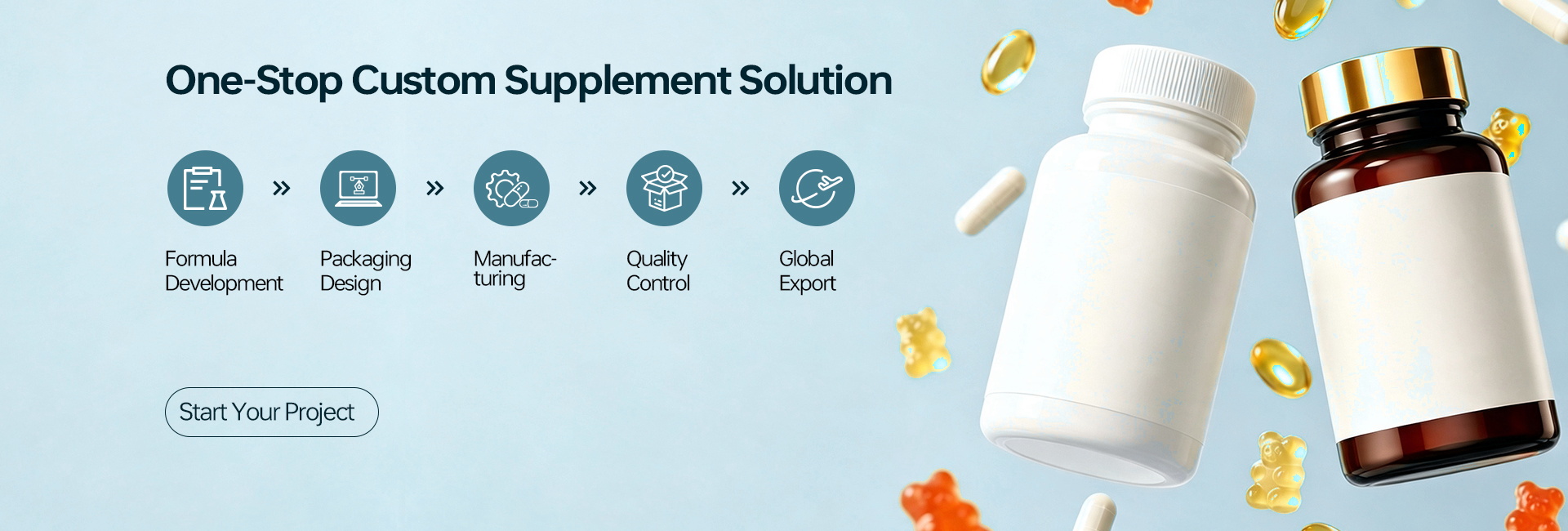
In the competitive dietary supplement market, packaging is more than a container for capsules, tablets, gummies, or powders. It is part of a brand’s identity, a source of product information, and an important consideration when buyers compare suppliers. For supplement brands, importers, wholesalers, and retailers, choosing the right private label supplement packaging can influence how a product is presented, distributed, and positioned in its target market.
A well-planned packaging strategy starts with the product itself. Brands need to consider the dosage form, target customer, sales channel, labeling requirements, and budget before selecting a bottle, pouch, jar, or other packaging format. When these decisions are discussed early with an OEM supplement manufacturer, businesses can better coordinate product specifications and packaging development.

1. Packaging Helps Communicate Brand Positioning
Packaging creates an initial visual impression before customers read the ingredient list or product description. Color, typography, container shape, label layout, and material selection can all contribute to the way a supplement brand presents itself.
For example, a brand focused on daily nutrition may prefer a clean, simple design that emphasizes product information and ease of use. A premium wellness brand may choose a more refined visual style, while a sports nutrition brand may favor bold typography and clear serving information.
These are design choices rather than guarantees of consumer preference. The most suitable approach depends on the target audience, competing products, sales channel, and brand identity.
For B2B buyers, packaging also helps communicate whether a product fits a retailer’s assortment or a distributor’s portfolio. Consistent visual elements across a product range can make it easier to present multiple SKUs under one brand.
Before approving a design, define the brand’s positioning and identify the key information that customers should notice first. This creates a clearer brief for designers and packaging suppliers.
2. Choose a Packaging Format That Matches the Product
The appropriate packaging format depends on the supplement’s dosage form, physical characteristics, serving size, storage needs, and distribution requirements. A format that works well for capsules may not be suitable for every powder or liquid product.
Common options include:
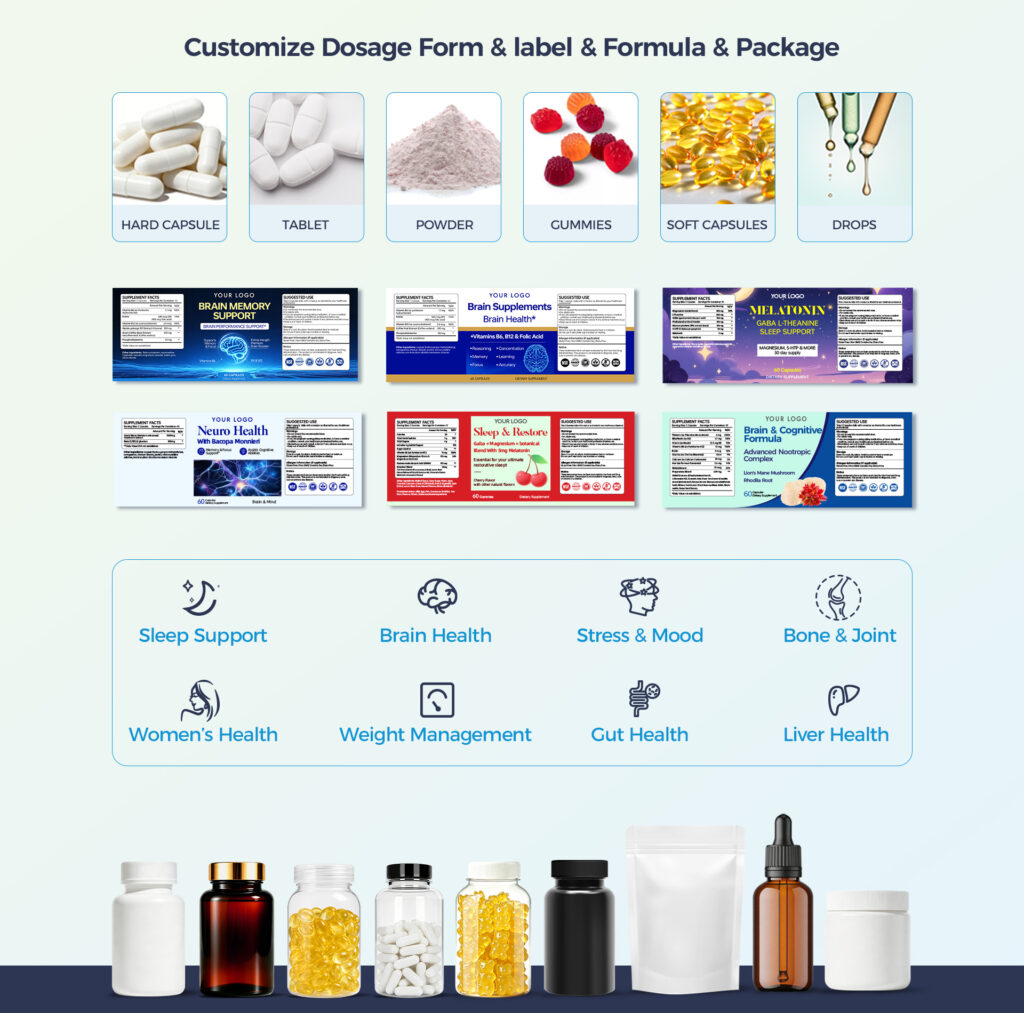
- Bottles: Frequently used for capsules and tablets, with different sizes and closure options available depending on the supplier.
- Pouches: May be considered for selected powder products or other suitable formats where the packaging specifications support the intended use.
- Jars and containers: Can be evaluated for products that require a wider opening or a particular presentation.
- Sachets: May suit single-serving powders or other products designed for individual portions.
- Liquid containers: Need to be selected according to the formulation, closure, compatibility, and handling requirements.
Not every manufacturer offers all packaging formats, materials, or customization options. Buyers should confirm availability and technical suitability with the supplier.
Packaging selection should also consider shipping and storage. Container dimensions, weight, closure design, and outer cartons can affect packing arrangements and logistics costs. For products intended for international distribution, buyers should discuss transport conditions and packaging protection before approving the final configuration.
3. Make Product Labels Clear and Market Appropriate
A supplement label needs to do more than look attractive. It should communicate product information clearly and meet the applicable requirements of the destination market.
Depending on the product and jurisdiction, relevant information may include the product identity, ingredient declaration, serving information, net quantity, directions for use, warnings, responsible business details, and other mandatory statements.
The exact requirements vary by market and product category. Brands selling in the United States, the United Kingdom, or European Union countries should not assume that a single label will automatically satisfy every market’s rules.
Health and performance claims require particular attention. Statements about specific benefits, ingredients, or product effects may be subject to local restrictions and substantiation requirements. A visually appealing label cannot compensate for an inaccurate or noncompliant claim.
For this reason, buyers should review the wording and layout before artwork approval. Confirm that the product formula and ingredient information match the approved specifications, and obtain qualified regulatory advice where necessary.
A practical approach is to create a label checklist early in the project. This helps the brand identify required information before finalizing the design and reduces the likelihood of major artwork revisions later.
4. Balance Customization With Budget and Order Requirements
Custom packaging can help a brand distinguish its products, but every additional design or material requirement should be evaluated against the project’s commercial objectives.
Buyers may need to compare standard containers with customized colors, printed packaging, special closures, or other branding elements. The cost implications can depend on packaging materials, printing methods, tooling requirements, order quantity, and supplier arrangements.
Before requesting a quotation, prepare a clear packaging brief that includes:
- Preferred container or pouch type
- Approximate dimensions and required capacity
- Label size and artwork requirements
- Preferred materials, colors, and closure type
- Required language and market-specific information
- Estimated order quantity and target budget
Ask the supplier to identify which components are standard and which require customization. Also clarify any minimum order requirements, setup costs, artwork responsibilities, and the treatment of unused packaging materials where relevant.
A quotation should be evaluated as part of the total project cost, not only by the unit price of the empty container. Packaging, filling, labeling, cartons, freight, and other agreed services may contribute to the final landed cost.
For distributors and wholesalers, the goal is to find a balance between brand differentiation, practical packaging requirements, and sustainable commercial margins.
5. Coordinate Packaging With OEM Supplement Manufacturing
Private label packaging decisions are closely connected to formula development and production planning. The packaging format, serving count, label dimensions, and product specifications should be reviewed together rather than handled as unrelated tasks.
For example, changing the serving size can affect the number of capsules or tablets in a container. A different container may require a revised label layout, while a new material or closure may need additional suitability checks.
Buyers should therefore share packaging requirements with their OEM supplement manufacturer as early as possible. The project team can then clarify what information is needed, which packaging options are available, and what needs to be confirmed before production.
Guangzhou Meichuntang Biotechnology Co., Ltd., associated with Orange Vita, describes its services as including OEM and ODM support, customized formulas and packaging, and private label manufacturing. Buyers considering a project should contact the company to confirm the packaging options, design support, minimum order requirements, and production arrangements available for their specific product.
When comparing manufacturers, look beyond the phrase “custom packaging.” Ask what the service actually includes. Does the supplier source packaging components, apply labels, coordinate artwork, or support the complete product packaging process? The answer should be documented in the quotation or project agreement.
6. Consider Storage, Protection, and Distribution
Packaging also has a functional role in protecting the product throughout storage and distribution. The right solution depends on the formulation, packaging materials, closure system, environmental conditions, and intended shelf life.
Buyers should discuss relevant protection requirements with the manufacturer, including moisture sensitivity, light exposure, closure integrity, and any special handling considerations applicable to the product.
Where needed, ask what evidence or testing is available to support the proposed packaging configuration. Do not assume that a container is suitable for every formula simply because it is commonly used for supplements.
For international shipments, outer cartons and packing arrangements also matter. Buyers should confirm the agreed packing configuration, shipping marks, carton information, and responsibilities for transport arrangements before the order is dispatched.
Clear specifications help reduce confusion when the product moves between manufacturing, warehousing, freight, and distribution partners.
7. Build a Consistent Packaging System Across Product Lines
Brands planning to launch several supplements should consider packaging as a product-line system rather than making every SKU look unrelated.
A consistent logo, typography system, label structure, and visual hierarchy can help connect products across categories. Different colors or secondary design elements can distinguish individual formulas while preserving the overall brand identity.
For example, a brand selling women’s wellness, daily vitamins, and digestive health products might use a shared design framework while assigning each category its own color or visual cue. This is one possible approach; the final system should reflect the brand’s audience and positioning.
A packaging system can also make future product launches easier to coordinate. Before expanding a range, however, brands should confirm that the selected container sizes, label templates, and materials remain suitable for the new formulas.
Maintaining approved artwork files and packaging specifications can support more consistent repeat orders. Any proposed changes should be reviewed and documented before production.
Final Thoughts
Private label supplement packaging influences how a product is presented, how clearly its information is communicated, and how well it fits a brand’s commercial strategy. The best packaging choice balances brand identity, product suitability, labeling requirements, manufacturing capabilities, budget, and distribution needs.
For supplement brands, importers, and wholesalers, the process should begin with a clear brief and continue through supplier confirmation, label review, packaging approval, and production planning.
If you are developing a private label supplement, prepare your product specifications, target market, packaging preferences, and estimated order quantity before approaching an OEM or ODM manufacturer. A structured discussion can help clarify available options and establish a more reliable foundation for your product launch.
Subscribe to our newsletter!