

Choosing an OEM supplement manufacturer is an important decision for any dietary supplement brand. The right supplier needs to match your product requirements, commercial goals, quality expectations, and target market. For importers, wholesalers, distributors, and private label brands, evaluating these factors before placing the first order can help reduce misunderstandings and improve project planning.
A competitive quotation is useful, but it should not be the only basis for a decision. Buyers should also review manufacturing capabilities, minimum order quantities, sample arrangements, product documentation, communication, and the terms of the proposed agreement.
1. Confirm That the Manufacturer Can Produce Your Product
Start by confirming whether the supplier can manufacture your intended product in the required dosage form. Dietary supplements may be produced as hard capsules, softgels, tablets, effervescent tablets, gummies, powders, drops, or liquids. Not every factory supports every format.
Prepare a product brief before requesting a quotation. Include the intended ingredients, dosage form, serving size, packaging preferences, target market, and estimated order quantity. If you have a reference product or existing formula, explain which characteristics must be maintained and where customization is acceptable.
Ask the manufacturer to confirm which requirements it can support and which details need further technical review. Ingredient compatibility, serving size, packaging specifications, and production arrangements may affect feasibility and cost.
It is also worth asking whether the supplier offers OEM manufacturing, ODM development, private label services, or only selected parts of the process. These terms can describe different levels of involvement, so request a clear explanation of the actual services included.
2. Evaluate Relevant Manufacturing Experience and Capabilities
A supplier’s experience should be considered in the context of your project. A company may have broad manufacturing experience, but buyers still need to confirm whether its facilities, equipment, processes, and product categories match the proposed order.
Review the company’s business information and ask for details about the facility responsible for your product. If certifications are relevant to your purchasing requirements, request current supporting documents and verify their scope, validity, and issuing organization.
Other useful questions include:
- Which dosage forms can the facility manufacture?
- Does the supplier support custom formulas and packaging?
- What product specifications and documentation can it provide?
- How does it communicate production changes or project issues?
- Can it explain the process from specification approval to shipment?
Avoid judging a manufacturer only by the number of products shown in its catalogue. A more useful evaluation focuses on whether the supplier can explain your product requirements clearly and document the proposed manufacturing arrangement.
3. Compare MOQ and Pricing on an Equal Basis
Minimum order quantity (MOQ) is often a key consideration for new brands and distributors. However, the lowest MOQ is not automatically the best commercial option, just as the lowest unit price does not necessarily represent the lowest total cost.
Ask each supplier to clarify the MOQ for the specific formula, dosage form, packaging configuration, and order arrangement. Custom ingredients, printed packaging, special materials, or other project requirements may affect minimum quantities.
When comparing quotations, make sure the prices cover equivalent specifications. Confirm whether the quoted amount includes the product, filling, packaging, labeling, testing or documentation that has been agreed upon, and any other relevant services.
Also clarify costs that may be quoted separately, such as samples, formula development, artwork, packaging setup, freight, or other project charges. Not every supplier structures quotations in the same way.
A useful comparison should include the total expected cost, payment terms, estimated production schedule, and the responsibilities of each party. This gives you a more realistic basis for evaluating offers than unit price alone.
4. Request Samples and Assess Product Suitability
Where samples are available, use them to evaluate the product against your written requirements. Sample review is especially useful when you are developing a customized formula, selecting a dosage form, or assessing packaging options.
Depending on the product, review its appearance, flavor, odor, texture, capsule or tablet characteristics, powder behavior, and packaging presentation. Check the available product information against the proposed formula and serving specifications.
If the sample does not meet expectations, provide specific feedback. Identify the characteristic that needs adjustment and ask whether the change could affect the formula, cost, packaging, or production schedule.
Before approving a sample, clarify whether it represents the intended commercial formula and packaging or is only a preliminary development sample. Request written confirmation of the final specifications to be used for the order.
Sample fees, availability, revision policies, and timelines vary by supplier. Confirm these details before assuming that samples will be free or that repeated revisions are included.
5. Review Quality Documentation and Certifications
Product documentation helps buyers understand what has been specified, tested, and agreed upon. Depending on the project, relevant records may include product specifications, ingredient documentation, certificates of analysis, batch information, and applicable manufacturing or quality certifications.
Ask which documents are available for your product and when they can be provided. Review whether the documents identify the correct product, ingredient, facility, or batch where applicable.
Certifications should be checked carefully. Confirm the certificate holder, facility address, validity period, issuing organization, and scope. A facility-level certification should not automatically be interpreted as a separate certification for every finished product.
Likewise, a certificate of analysis only reports the tests and results within its stated scope. It should not be assumed to demonstrate every possible quality attribute.
If you are selling in the United States, the United Kingdom, the European Union, or other regulated markets, determine the documentation and compliance requirements applicable to your product. A supplier may provide technical information, but buyers should independently confirm their own regulatory and import responsibilities where necessary.
6. Assess Communication and Project Management
Clear communication is an important part of supplier evaluation, particularly when the buyer and manufacturer are working across different countries and time zones.
During the quotation stage, observe whether the supplier answers questions directly, explains unclear specifications, and identifies information needed to move the project forward. A supplier that asks relevant questions may help uncover practical issues before production begins.
Before placing the order, establish who will handle formula confirmation, artwork approval, packaging coordination, production updates, document requests, and shipment communication.
It is also helpful to agree on how changes will be documented. If the formula, packaging, quantity, or delivery arrangement changes, both parties should understand how the revision is approved and whether it affects the price or schedule.
Professional communication cannot guarantee a problem-free order, but written decisions and clearly assigned responsibilities can make project management more predictable.
7. Confirm Commercial Terms Before Ordering
Before making a payment or issuing a purchase order, review the complete order terms. These should match the product specifications and quotation you have approved.
Confirm the product name, formula or specification version, dosage form, quantity, packaging, unit price, total price, payment terms, estimated production schedule, shipping arrangements, and required documents. Make sure any agreed additional costs or special conditions are recorded.
Buyers should also clarify the process for reporting discrepancies, damaged goods, or other quality concerns. The relevant responsibilities and remedies should be stated in the applicable agreement rather than left to assumptions.
For repeat orders, retain approved specifications, artwork, purchase records, and relevant product documentation. Before reordering, confirm whether any ingredients, packaging components, or manufacturing arrangements have changed.
Choosing a Suitable OEM Partner for Your Brand
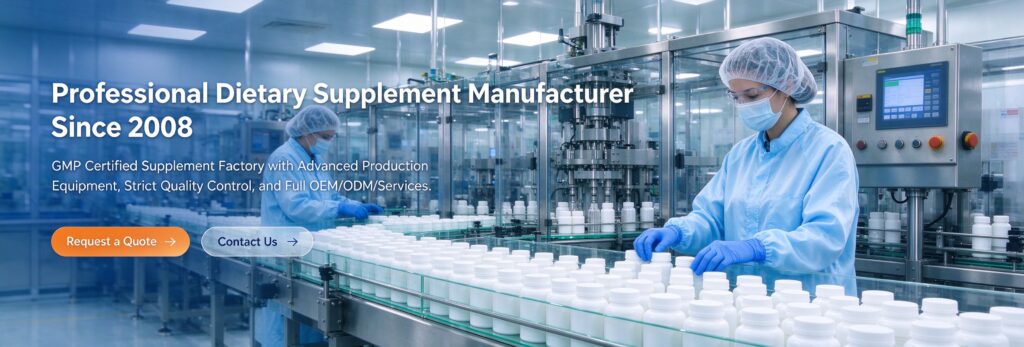
Guangzhou Meichuntang Biotechnology Co., Ltd., associated with Orange Vita, describes its services as including OEM and ODM support, customized formulas and packaging, private label manufacturing, and multiple dosage forms. Buyers considering a project should confirm the current capabilities, minimum order requirements, documentation, and commercial terms relevant to their specific product.
When comparing Meichuntang with other potential suppliers, use the same product brief and evaluation criteria for each quotation. This makes differences in pricing, services, specifications, and project requirements easier to identify.
Final Thoughts
Evaluating an OEM supplement manufacturer requires more than finding an attractive price. Buyers should confirm product suitability, review manufacturing capabilities, compare complete quotations, assess samples, verify relevant documentation, and agree on commercial terms before placing the first order.
A structured evaluation process helps supplement brands and distributors ask better questions, identify potential gaps early, and establish clearer expectations with their manufacturing partners.
Before starting your next private label supplement project, prepare a product brief and a list of required specifications and documents. Then compare suppliers based on their ability to meet those requirements, not simply on the number of products they offer or the lowest price they quote.

Subscribe to our newsletter!